3.3 The versions
From I to V one question grows: from boids that make sound one by one to a swarm whose emergence becomes the music. Three threads run through all five versions — the three sliders that set the rules, the sine wave, and lines in space that sound when they are crossed.
| year | occasion | where the sound comes from | |
|---|---|---|---|
| I | 2018 | first study (June) | every boid crossing a line of a grid retunes a chord of layered sines |
| II | 2018 | second study (June – July) | a boid crossing a grid line strikes a single note, seen as expanding rings |
| III | 2018 | speculative objects; exhibition ’17 Retrospective, Frankfurt (August) | the colours of images under the agents become frequencies |
| IV | 2019 | installation, KunstKulturKirche Allerheiligen, Frankfurt (November); live performance “Flock” with Orm Finnendahl | boids crossing four horizontal sine strings retune them; a group plays tones of its own |
| V | 2026 | Emergence; instrument and composition tool | relations: every flock sings, encounters ring tuned notes, flocks crossing a grid keep time |
3.3.1 Swarm Synth I (2018)
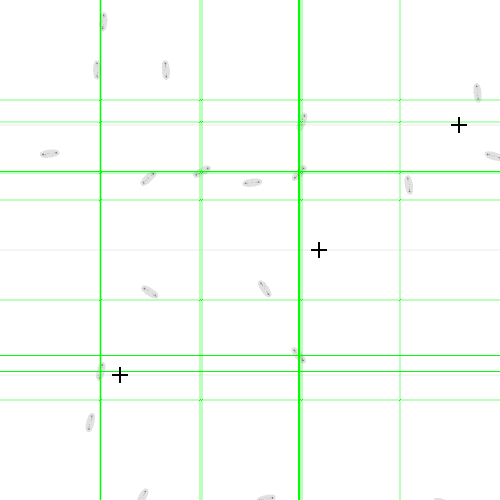
The first study, made in June 2018. A grid of lines lies over the stage; every boid that crosses a line retunes a chord of five layered, slightly detuned sine waves — the pitch from the boid's height, the detune from its position left and right. The swarm plays one instrument, and only its movement counts. Three sliders set the radii of the three rules, as in every version since.
3.3.2 Swarm Synth II (2018)
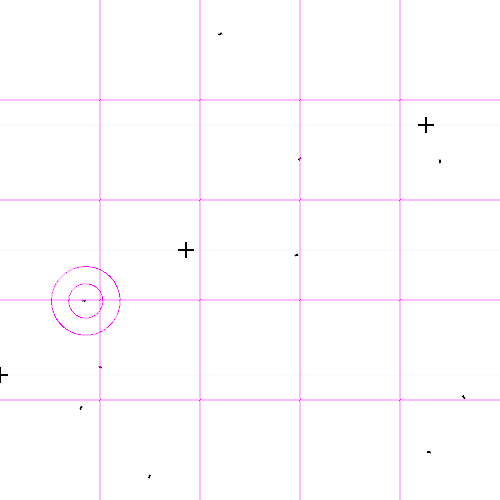
Made in June and July 2018. The same grid now strikes notes: a boid crossing a line plays a single tone, a triangle wave with an envelope — its pitch from the boid's height, its length from its distance to the centre, its loudness from its speed — and expanding rings show where it sounds. These are the first individual voices. Late in II, a MIDI controller took over the sliders.
3.3.3 Swarm Synth III – speculative objects (2018)
Made for the exhibition ’17 Retrospective in Frankfurt am Main, August 2018, which I helped a friend prepare (3.2). The swarm reads images: any picture can be loaded, and the colour under each agent becomes the frequency of a sine wave, so that the installation “speculates” on hidden aspects of the image. From the exhibition I chose works by Provides Ng, Vamsi Krishna Vemuri, Keyur Mistry, Becca Nayagam and Miriam Kuhlmann.
Swarm Synth III – speculative objects
August 2018 · exhibition ’17 Retrospective, Frankfurt am Main · the swarm reads the colours of the exhibited works, here the drawings of Provides Ng · 1:37

Original exhibition text, August 2018 (PDF)
3.3.4 Swarm Synth IV (2019)
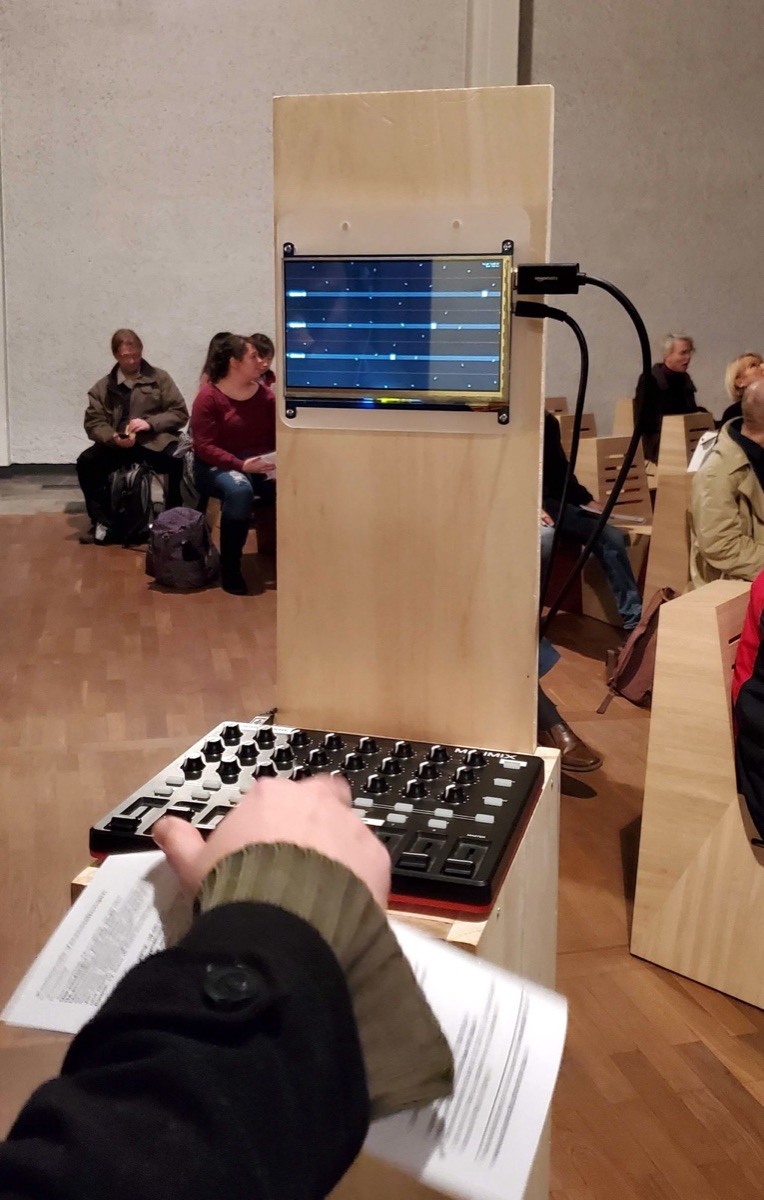
An interactive audiovisual installation with headphones, a display and a MIDI controller, shown at the KunstKulturKirche Allerheiligen in Frankfurt on 5 November 2019, in “shortcuts – Experiment und Begegnung”, an evening of the Institute for Contemporary Music (IzM) of the Frankfurt University of Music and Performing Arts (HfMDK) and the KunstKulturKirche; with Orm Finnendahl it also became the audiovisual live performance “Flock”. Four horizontal “sine strings” cross the stage: every boid that crosses one retunes its sine, and when boids form a group, the swarm plays tones of its own. The three sliders — separation, alignment, cohesion — sit on the controller; the picture is dark, faint and retro.

Original exhibition text, November 2019, in German (PDF)
Programme of the evening, November 2019, in German (PDF)
3.3.5 Swarm Synth V – Emergence (2026)
The flock itself sings. The sound comes from relations — two boids meeting, flocks forming and flying together, flocks crossing an invisible grid — measured and traceable, so that what one sees is what one hears. V is an instrument to be played live, with keys, mouse or a MIDI controller, and a tool for composition: scores reproduce a performance exactly and are rendered to video. Chapters 1 and 2 describe it in full.